
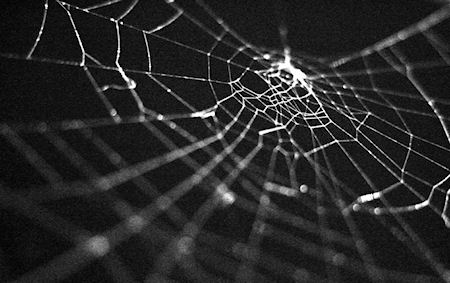
Spiders use Electrical Attraction to Lure Prey

spiwestat

A recent study published in Scientific Reports, an online science journal, revealed that webs of the common garden spider – made from silk thread – are attracted to electrostatically charged objects. Honeybees and fruit flies, for example, generate an electric charge when they flap their wings.

Positively charged insects and water droplets falling towards a grounded orb web reveal rapid and substantial web attraction. Radial and particularly spiral silk threads are quickly attracted to the electrified bodies. VIA: –PRESURFER

Disgarded DNA Art

Heather-Dewey-Hagborg-sculpture7

Artist Heather Dewey-Hagborg‘s project, Stranger Visions, is a wonderful mix of science and art.  Dewey-Hagborg turns a poetic attention to the seemingly innocuous artifacts of life: a hair, chewed gum, a cigarette butt.  Beyond sight, though, the DNA remains of each unique person inhabits these “artifacts”.  She picks up these remains up throughout Brooklyn and brings them to a nearby biology lab.  Dewey-Hagborg extracts the DNA from the object, then information from the DNA.  She runs the information through a program she has written herself that is able to determine physical features such as eye color, hair color, gender, nose width, and so on.  That information is then exported to a 3D color printer to create a sculptural portrait of the unwitting donor.

The Clock that Tracks the End of the World

cloendwor

Maybe you’re familiar with the Doomsday Clock. It’s an analogy started by the Bulletin of Atomic Scientists to track how we close we are to the apocalypse by way of nuclear war or other global disaster. Midnight means the end of the world.

Artist Tom Schofield went ahead and turned that analogy into reality with a clock, which automatically checks the Bulletin’s site for updates on the human race’s demise. VIA: –THE PRESURFER