
San Francisco Bay Area photographer Robert Buelteman takes extraordinary images of flowers subjected to 80,000 volts of electricity. But he doesn’t use traditional equipment, not even a camera. VIA: –AMUSING PLANET–

San Francisco Bay Area photographer Robert Buelteman takes extraordinary images of flowers subjected to 80,000 volts of electricity. But he doesn’t use traditional equipment, not even a camera. VIA: –AMUSING PLANET–

–GALLERY–
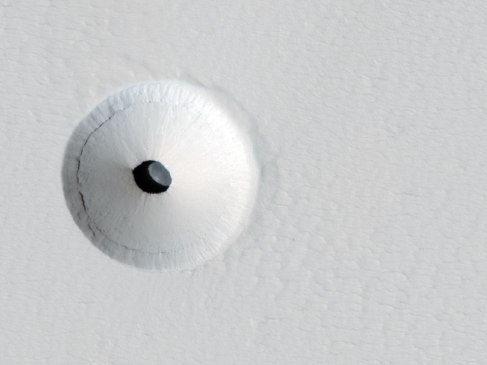
What created this unusual hole in Mars? The hole was discovered by chance on images of the dusty slopes of Mars’ Pavonis Mons volcano taken by the HiRISE instrument aboard the robotic Mars Reconnaissance Orbiter currently circling Mars. The hole appears to be an opening to an underground cavern, partly illuminated on the image right. Analysis of this and follow-up images revealed the opening to be about 35 meters across, while the interior shadow angle indicates that the underlying cavern is roughly 20 meters deep. Why there is a circular crater surrounding this hole remains a topic of speculation, as is the full extent of the underlying cavern. Holes such as this are of particular interest because their interior caves are relatively protected from the harsh surface of Mars, making them relatively good candidates to contain Martian life. These pits are therefore prime targets for possible future spacecraft, robots, and even human interplanetary explorers. –LINK–

These amazing long exposure photographs were taken by astronaut Don Pettit from aboard the International Space Station during Expedition 31.
As the ISS circles Earth at roughly 17,000 miles per hour, Flight Engineer Don Pettit takes 30-second exposures with a stock digital camera, then stacks those exposures into single frames that produces 10-15 minutes of exposure. The rotation is fast enough for long exposures to blur the earth into bright strips of light, as well as capturing star trails, aurora, and flashes of lightning splattered all across the surface of the Earth.
View more photos at this Flickr set VIA: –AMUSING PLANET–

Yeah, I know I’ve been posting a lot from –BEAUTIFUL DECAY– lately, what’s it to ya?!
 CONSPIRAPORN!

