
San Francisco Bay Area photographer Robert Buelteman takes extraordinary images of flowers subjected to 80,000 volts of electricity. But he doesn’t use traditional equipment, not even a camera. VIA: –AMUSING PLANET–

San Francisco Bay Area photographer Robert Buelteman takes extraordinary images of flowers subjected to 80,000 volts of electricity. But he doesn’t use traditional equipment, not even a camera. VIA: –AMUSING PLANET–
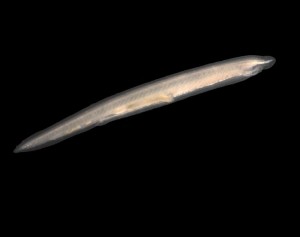
Over 500 million years ago, a spineless creature on the ocean floor experienced two successive doublings in the amount of its DNA, a “mistake” that eventually triggered the evolution of humans and many other animals, a new study has claimed.

Described as “one of the most beautiful and powerful sites in Ireland,” the megaliths at Loughcrew comprise a set of tombs enshrouded in mystery. For thousands of years they have stood, high on the windswept hills, with views of a gentle green landscape rolling away on all sides. Before the first pyramids were even built in Egypt, this wild and rugged land was home to Neolithic people who carved strange patterns into the stones. And yet it is the mystery that enshrouds this tomb site in Loughcrew, in Ireland’s County Meath, that is the real secret to its appeal.
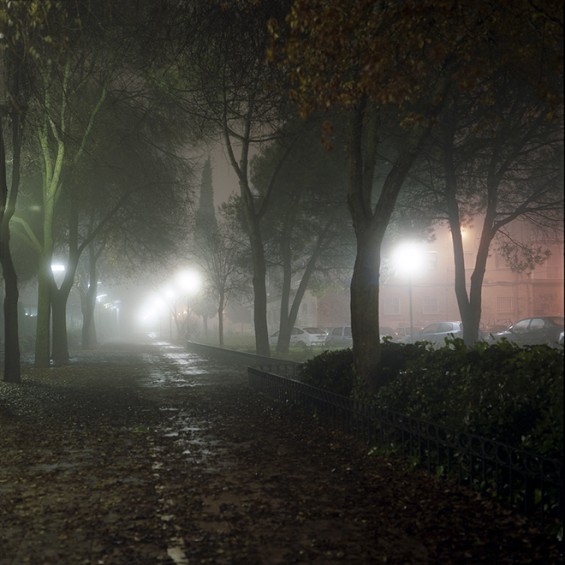
Spanish Photographer Andres Medina has a knack for creating beauty with very little. There’s really not too much action in a lot of his photographs. Somehow, though, he frames such emptiness with beautiful lighting and technique in a way that amplifies the emptiness of the world in a really appealing way. Some of Medina’s best stuff is taken at night. You can almost feel the moist, cold air in his night photos, and your ears prick up as you are drawn into their silent world.
MORE AT: –BEAUTIFUL DECAY–
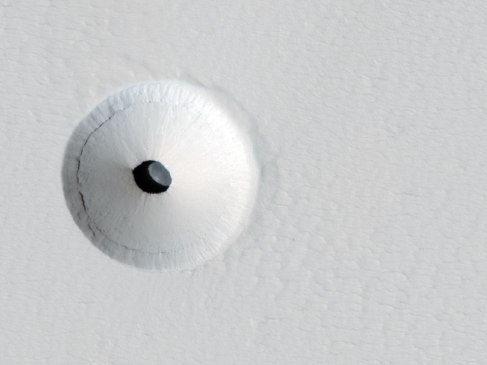
What created this unusual hole in Mars? The hole was discovered by chance on images of the dusty slopes of Mars’ Pavonis Mons volcano taken by the HiRISE instrument aboard the robotic Mars Reconnaissance Orbiter currently circling Mars. The hole appears to be an opening to an underground cavern, partly illuminated on the image right. Analysis of this and follow-up images revealed the opening to be about 35 meters across, while the interior shadow angle indicates that the underlying cavern is roughly 20 meters deep. Why there is a circular crater surrounding this hole remains a topic of speculation, as is the full extent of the underlying cavern. Holes such as this are of particular interest because their interior caves are relatively protected from the harsh surface of Mars, making them relatively good candidates to contain Martian life. These pits are therefore prime targets for possible future spacecraft, robots, and even human interplanetary explorers. –LINK–
 CONSPIRAPORN!

