
The Poison Garden

The Alnwick Poison Garden is one of the many public gardens attached to Alnwick Castle in Northumberland, England. The castle itself is the second largest in Great Britain. The Alnwick Poison Garden boasts some of the world’s most dangerous plants, hence the name. Behind big black gates, the carefully curated garden contains about 100 varieties illegal narcotics including poppies, which are used to make opium, the poisonous Atropa belladonna (also known as deadly nightshade), Strychnos nux-vomica (used to make strychnine), Cocoa (from which cocaine is produced), hemlock (used to kill Socrates), cannabis and more.

The Brain Phone Booth

I don’t know what’s more remarkable: that this phone booth is shaped like a brain, or that there is a public phone still existing somewhere. This is an art installation in Sao Paulo, Brazil, where there are at least 100 phone booths. All of them are part of an art project in which 100 artists were invited to make something of them. The stunt is part of a transition phase by the telephone company that is rebranding and repainting the public phone facilities, which will all eventually look the same. The brain phone is the work of artist Carla Pires de Carvalho Fernandes. Link -via NEATORAMA

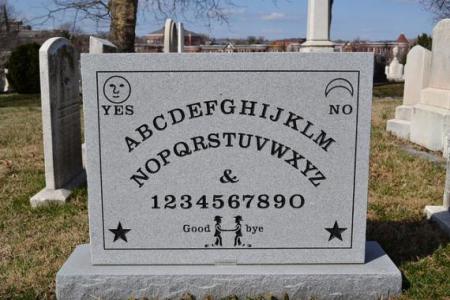
Ouija Board Tombstone

It wasn’t until 2007 that Robert Murch, a noted paranormal enthusiast and Ouija Board collector and historian, set out to find the grave, and Elijah Bond finally got the respect he deserved for his invention. Murch claims it took him fifteen years to locate the precise grave in the Green Mount Cemetery in Baltimore, Maryland – and several of those spent working closely with the cemetery owners themselves to accurately identify the grave.

VIA: –SHE WALKS SOFTLY

The Museum of Endangered Sounds

Imagine a world where we never again hear the symphonic startup of a Windows 95 machine. Imagine generations of children unacquainted with the chattering of angels lodged deep within the recesses of an old cathode ray tube TV. And when the entire world has adopted devices with sleek, silent touch interfaces, where will we turn for the sound of fingers striking QWERTY keypads? Tell me that. And tell me: Who will play my GameBoy when I’m gone?

My ten-year plan is to complete the data collection phase by the year 2015, and spend the next seven years developing the proper markup language to reinterpret the sounds as a binary composition.


MORE AT: –SAVE THE SOUNDS