
Designer Revital Cohen’s The Immortal installation consists of five hacked life support machines so that they each keep one another alive. Each machine is circulating liquids and air in attempt to mimic a biological structure.
VIA: –BEAUTIFUL DECAY–

Designer Revital Cohen’s The Immortal installation consists of five hacked life support machines so that they each keep one another alive. Each machine is circulating liquids and air in attempt to mimic a biological structure.
VIA: –BEAUTIFUL DECAY–

Global Rainbow is a large scale, spectacular outdoor laser projection created by the artist, Yvette Mattern. It consists of seven parallel beams of high specification laser light, representing the spectrum of the traditional seven colors of the rainbow, and is designed to be projected across large open sites, particularly densely populated areas. With the projection, the artist intends to encompass geographical and social diversity in its reach and symbolize hope. (via)

Imagine the Earth in your mind’s eye. Now round up all the water on the planet into a sphere (we’re talking oceans, icecaps, atmosphere, everything — even the water bound up in you and me). How big do you think that sphere would be compared to the Earth?

It is a question that has long puzzled scientists. What made our ancestors break away from apes and advance so dramatically?
Now researchers believe they may have explained the missing link – a duplicated gene.
Researchers believe that a copy of gene SRGAP2, which appeared in ‘ape men’ around 2.5million years ago, helped our brain cells move faster and make more connections – enabling the brain to become more complex.
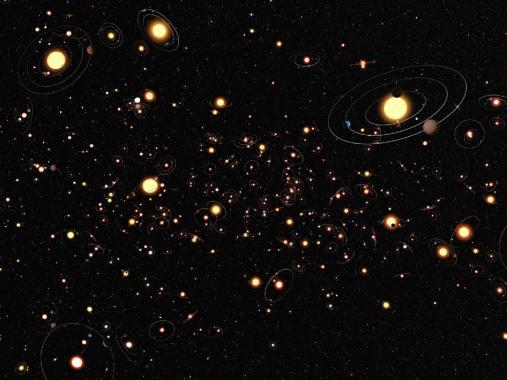
This artist’s illustration gives an impression of how common planets are around the stars in the Milky Way. The planets, their orbits and their host stars are all vastly magnified compared to their real separations. A six-year search that surveyed millions of stars using the microlensing technique concluded that planets around stars are the rule rather than the exception. The average number of planets per star is greater than one. This means that there is likely to be a minimum of 1,500 planets within just 50 light-years of Earth.
 CONSPIRAPORN!